

Introduction
Selecting a program of study can be overwhelming. Without guidance or when contrasting opinions are thrust at you from friends and family, the pressure can feel like a life or death situation.
Many times, we get messed up because we make a career ‘the goal’ in life and subsequently spend a lot of time trying to make the best decision on a study or career path that gets us to that goal. We get disappointed when we later find out that life isn’t as linear as we initially thought and might even be tempted to call ourselves failures if we don’t reach the initially specified goal.
But it’s not that deep. I believe that everyone’s natural goal in life is to live, but the purpose of life is learning. At the end of the day, what makes you successful or sustains the material wealth which most classify as success is your substance, gained from your exposure and life’s learnings. How you’re able to influence and impact people with the quality of your personality, will live after you’re long gone.
Yes, what you study and the career path you choose is important, but unlike what many students think, it seldom has the final say on your career path. I know of engineers who are business executives, programmers who run a marketing agency, an accountant who works in diamond processing amongst many other examples. I, for one, studied my passion much later on in life after enjoying successes in other lines of work.

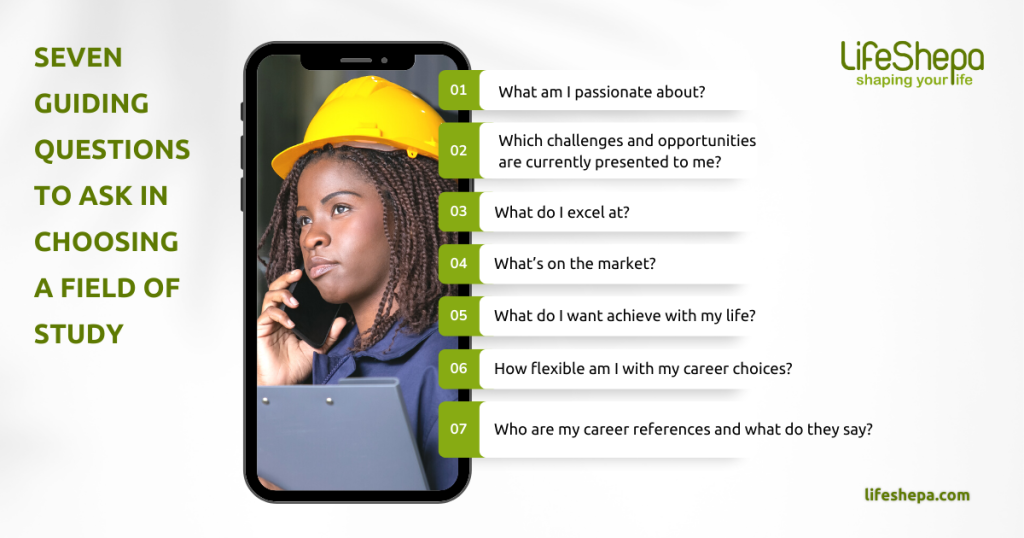
The decision on what you study alone will not make or break your career or life, but with adequate guidance, it can smoothen your journey to success. I’ve put together seven guiding questions which will help you choose your degree program, an area of study, career path or perhaps transit between jobs.
Let’s discuss them in detail.
- What am I passionate about?
The old adage says that if you make your passion your work, you’ll never have to work a day in your life. Well, they’re just about right. However, knowing your passion can be a huge task on its own.
For some who may have been musicians from the age of five when they never left the shower room or others who were given a ball in kindergarten and never gave it up, it could be easier to decipher your passion.
For the rest of us, our passions may constantly change with experience, exposure and time. Don’t be afraid to try out new things and fail at them. At any decision point, it’s a good idea to go with what you’re obsessed with. When and if that changes, you can change along with it.
- What do I excel at?
There’s a difference between what you like and what you’re good at. Depending on your goals, it may be a masterstroke to use what you excel at as a springboard to do what you’re passionate about. I like a verse from the bible that says, “A man’s gift makes room for him, and brings him before great men.” – Provers 18 v 16
Perhaps you’re a math wiz who enjoys anthropology, don’t be afraid to study mathematics if it can potentially put you in a room with distinguished anthropologists you may then learn from. Life isn’t as linear as we like it to be, and never make decisions in a vacuum.
- Which challenges and opportunities are currently presented to me?
Speaking of making decisions in a vacuum, you may need to assess your situation and immediate environment. In as much as it’s ideal to just aim for only your passion and then you’re set, we don’t live in a perfect world.
If you find yourself in a situation where your intended career path takes much longer to realize yet you’ve pressing needs, be unafraid to pivot. For example, you may want to study neurology which takes a couple of years and unfortunately lacks the funding, coupled with having dependents who have immediate needs. You don’t have to necessarily give up your dream but it may mean it’ll take you a little bit longer to get there.

Similarly, you could have amazing opportunities thrown your way which are outside your career plan. It may not be the best decision to out-rightly discard a photography scholarship in a country of choice because you’re set on becoming an accountant.
Always take some time to assess your situation and make the best decision for yourself.
- Who are my career references and what do they say?
If you’re fortunate to have close family and friends who work in your field of interest, seek counsel from them. If possible, get practical experience of the career you seem to be interested in before making the decision to study about it.
It’s possible to think you like being a medical doctor because it was an idea fed to you by your parents or guardians from a young age, yet you can’t stand the sight of working with blood.
Be proactive and invest more time into understanding or experiencing your career of choice before committing to study about it.
- What do I want to achieve with my life?
To be fair, this is a much bigger question to answer. Some well accomplished people are still grappling with understanding their purpose. Don’t be pressured to find immediate answers to such a question but having it at the back of your mind will help streamline your decisions.
Ideally, you want to make your life and career choices according to your grand plan as opposed to being blown by every wind, hence the importance of always asking yourself the question on purpose.
- How flexible am I with my career choices?
It’s also important to acknowledge the difference in careers and the paths to get there. Some require hard and specific skills which make them less flexible than others.
If you’re set on becoming a lawyer, pilot or medical doctor for example, the paths to get there are well defined, linear and less negotiable. On the contrary, a finance executive may not need to study a specific program or attend a specific school. They would’ve broader choices.
- What’s on the market?
Finally, you’d also want to choose something that’s relevant and carries an economic value to help you achieve your other life’s goals.
Understand that I’m not talking about going for a career path because it has the highest reported salaries. Besides the trends being subject to change, always chasing the money will enslave you as opposed to becoming its master. If you diligently apply yourself to any field of interest, success is guaranteed, financial or otherwise.
The question of keeping an eye on the market largely speaks of, for example, being flexible to choose and learn how to make smart televisions because video cassette recorders (your bread and butter) have become obsolete.
Parting note
In summary, some of these questions may be more important to you than others but understanding them will help you consider all variables before making a sound decision. Additionally, you may also need to use one or more guiding questions and always remember to make the decision for yourself as opposed to pleasing those around you.
What’s your favorite guiding question so far?