

Let’s say you’ve evaluated your strengths, weaknesses, interests, and you’re set on a specific career path.
What does it take to shape that path and what kind of milestones do you need to achieve to live your dream?
In this series, we take a look at what it takes to become a medical doctor and a chartered accountant in Zimbabwe. These professions are technical and though subject to change, the steps we’ll discuss will give you a good foundation to understand the journey you’ll soon embark on.
MEDICAL DOCTOR
The first step is passing the required subjects, which at the minimum is a combination of three subjects from math, physics, biology, chemistry and any other related ones.

University time
Once you get admission into the school of medicine and health sciences (which is super competitive), you’d need to complete five years of study.
During the five years, apart from theoretical lectures and practicals, you’ll also get to intern at any of the recognised hospitals. In Zimbabwe, these are usually public hospitals.
The internships include rotations across most if not all hospital departments, from surgery, pediatrics, obstetrics, internal medicine and more. The idea is for you to get a feel of what it’s like to work with real patients and address real cases with the help of seasoned practitioners.
After university
At the conclusion of the five years, you graduate to become a Junior Registered Medical Officer (JRMO). At this stage, you essentially transition into practice but won’t be a certified medical doctor yet.
After working as a JRMO for a year and passing all practical assessments, you’d then work one more year as a Senior Registered Medical Officer (SRMO).
Finishing up your SRMO year will mean you become a Health/ Hospital Medical Officer, in other words, a medical doctor.
You could then be eligible to go into private practice or choose an area of specialization for further study.
CHARTERED ACCOUNTANT
There are two popular pathways.
Route 1
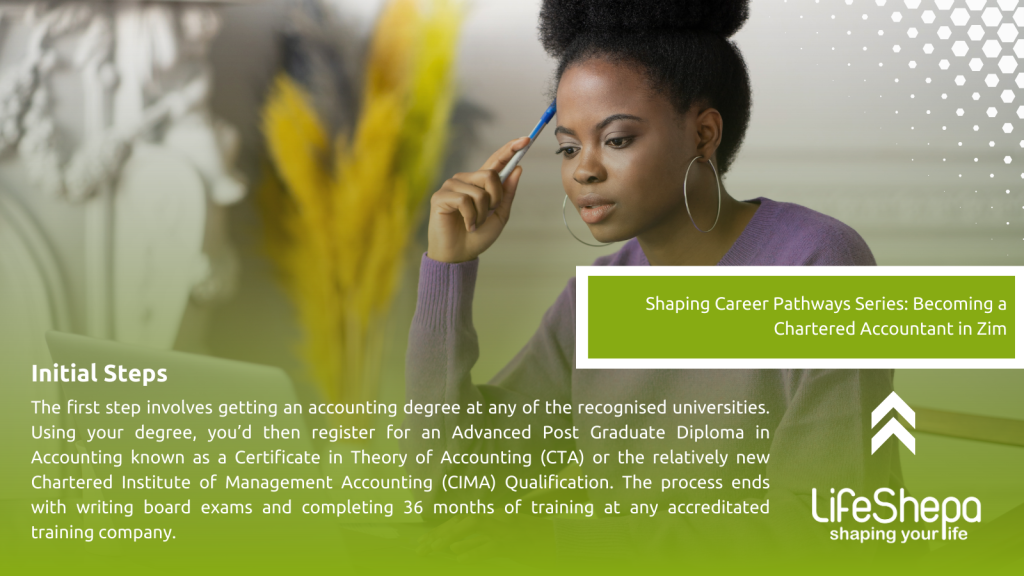
The first one involves getting an accounting degree at any of the recognised universities.
Using your degree, you’d need to register for an Advanced Post Graduate Diploma in Accounting known as a Certificate in Theory of Accounting (CTA).
The CTA can be done full or part-time over a period of two years (provided you’re passing all exams). After completing the CTA, you must then pass two major exams, Board 1 exam (Initial Test of Competence) and Board 2 exam (Assessment of Professional Competence).
The two exams, your CTA diploma and then 36 months of training with an accredited training office will earn you a Chartered Accountant certification[CA(Z)]. The training offices are usually audit firms as well as other certified companies.
You could also complete your hours before finishing the CTA if you’re working part-time at an accredited office.
Route 1b
In this path, instead of a CTA, you’d use your accounting degree to undertake a Chartered Institute of Management Accounting (CIMA) Qualification, and then write 8 exams to get a Management Accounting Qualification.
In the end, you’d then need to pass the Assessment of Professional Competence (APC) exam also known as Board 2 exam. Satisfying the 36 training months required by the Institute of Chartered Accountants in Zimbabwe (ICAZ) would still be required to get the CA(Z) designation.
Both these paths in route 1 can take an average of 6-9 years to complete.
Route 2
Audit firms offer an alternative pathway for high school students to skip traditional university.
You can get hired straight after high school to work with them as you also study for an accounting degree with an open university such as the University of South Africa (UNISA).

You’d also then need to complete the CTA as well as the two Board exams. The training hours will already be accounted for from the moment you start working with the firm.
Purpose of the courses
The overall experience is about developing you into a finance professional with an all round perspective. You’ll be strong in most finance aspects, compliance, reporting, audit, taxation and financial management.
Career progression is much quicker once you become a Chartered Accountant. Even as roles change and become more diverse, you can look forward to working as a Finance Manager, Auditor (Internal or external), Financial Planning and Analysis, Private Equity and more.
Parting note
Insights provided in this article were sourced from people in these professions and intended to give you a high level understanding of the milestones involved. For more detailed outlines, you’d need to consult resources provided by certification institutions.
Which careers do you want us to discuss in the next episode?